Wednesday, September 20, 2017


Mt.Semeru The Olympus of Java (part 3 of 3)

0

Sunrise at Top of Mt.Semeru

A long walk to Jambangan Point


I was all by myself again. Going on the route like this is exhausting, especially when you are alone. Luckily the path is very clear. I didn't want to get lost in the wilderness with no supply in hand. I kept praying that bad thing wont happen to me. Some places in Cemoro Kandang looked dark, due to the canopy up on the top of the trees. This add the creep in this place. I continued with 50/50 chance to reach the destination, so I thought. Sometimes the path lead me to hike up to the hills, or down to small dried rivers. Well it's normal to an adventurer like me. What's not normal is that being alone on this place.

It took approximately one hour hiking Cemoro Lawang path. At the end, we will see the Jambangan point. They say when you reach Jambangan point, means that it's already close to Kalimati. You'll know you are at Jambangan point when you see a written sign on the tree. It is rather flat route, just winding a bit. The vegetation here is also different from the one in Cemoro Kandang. The place is full of bushes here and there. Sometimes the route comes to dark big bushes full of creeping plants. It is like we're entering a cave made of plants and bushes.

But when you are out of the bushes cave, the mighty Mt.Semeru will welcome you from distance. Such a stunning view. This is all I ever wanted. A clear picture of the volcano itself with some clouds passing, on part of the top of Mt.Semeru. I also met some other hikers here, we helped each other to take pictures. I was so damn lucky.

Posing at Jambangan Point
Distance view of Mt.Semeru
Breathtaking scene from the jungle
Tree Trunk Bridge

Kalimati, the Dead River


Once again you'll find jungle similar to Cemoro Kandang, at the end of Jambangan Point. It's only 15 minutes I guess, passing this Jungle and you'll find Kalimati. If you find a bridge made of tree trunk, then you are near Kalimati. Entering Kalimati point makes me feel numb all over my body. It's cold like hell. Especially when the wind is passing by, and will be worse during the night. 

I thought I should find the group whom Dana is leading. I searched for him and his other group member by the face, though it's hard to remember. I walked the area, corner by corner, only to find a heartbreaking result. It was almost dark, impossible to get back by this time. I cannot imagine being in Cemoro Kandang at night. 

Desperate by the search, I met again this guy from Jambangan point. He told me to come following him to the Sumber Mani to get fresh water. Sumber Mani is a spring, being the only water resource to the hikers. So I followed him. The route going to the Sumber Mani is the reason they call it Kalimati literally means the dead river. It is a pathway for the lava from Mt.Semeru when it erupts, looking like river, with no flowing water, then it become The Dead River.

On my way, once again, I met Dana. Thanks God, I said. He told me where his tent is, and invited me to join his group after I finished getting the water. It was the best feeling I ever had through the journey so far. I got relieved from the burden I had all along. As if my life is saved by this coincidental meeting. I got no worry no more. At Sumber Mani I met his other group member, and we've got along quite well. So I went back to the camping ground with him. One good thing about hikers campared to other type of travelers is that, they are always friendly and very eager to help others, even though they just met somewhere in the mountain. I got to know the other members, then we talked this and that. They were really nice to me. 

Being in Kalimati camping ground was the closest point with the Volcano. You can see its top very clear. The mighty volcano and the surrounding scenery is the whole picture I ever wanted to see. There was no ambition to climb up the top, it was enough seeing Mt.Semeru from that close. We can also find the Edelweiss plants among the bushes in Kalmati. Sometimes fogs came to the area, and covered it up all over the place. Making me unable to see in distance, so was the volcano. But when it got clear, photo session with the volcano as background is a must.  

At the nearby Sumber Mani
Path to Sumber Mani
Mt.Semeru from Kalimati Camping Ground
Hikers in Foggy Land
Evening with the Hikers
With Dana the Savior

Land Above the Sky


Some of the group members planed to hike the top of Mt.Semeru. Dana, on the other hand, was deciding whether to join them or to stay at the camp. I was full of desire to join them too, and some of them encourage me to do so. But my clothing at the time didn't allow me to do that. I didn't prepare myself for such effort, hiking the top of Semeru. My jacket was very thin made of thin cloth, and I didn't carry anything else but my sleeping bed. So I decided not to go. I couldn't imagine how cold is up there, if Kalimati is already this cold. So I let one of them carry my pocket camera to get great pictures from the top, and he did.

At night, the Kalimati camping ground was very cold. One guy said it was -4' Celsius. We could only be around the fire we made earlier covered in sleeping bed to get warmth. One other good thing here is that, we can see the stars clearly. Such a beautiful night I had. There was only one disturbance from other tent in distance. We heard a girl screaming out loud. She screamed like she saw a Ghost there. The guy near me said that she is being possessed by other being. It is common believe to Indonesian in places like this, is a home to spiritual beings, so that we don't do anything bad here. If not, bad thing happen to us.

They say that being up on the top of Mt.Semeru, is like being in heaven. They call it "Negeri di atas Awan" meaning land above the sky. Coz from up there you'll see the sea of clouds covering lower part of the mountain as far as the eyes can see. It stunning I would say, though I haven't experienced it myself. The pictures they brought back were the proof of that statement. While I could only see them lining up carrying headlamps. The sunrise considered as one of the most beautiful in the world. They got lucky as the sky was clear. So the sunrise they capturing was amazing. I, on the other hand, had a very good sleep, coz I could use all the sleeping bed they left behind.

Stunning Colors at Sunrise
Truly the Land Above the Sky
Surrounding Mountainous Area of Bromo Tengger Semeru national Park
Such Stunning Picture
The Golden Sunrise
This what we call "The Endless Beauty"
Complete Story »

Tuesday, September 19, 2017

Mt.Semeru The Olympus of Java (part 2 of 3)

0
Hikers at the Oro-oro Ombo

The New Friends, or I would say The Saviors


The time I arrived at Ranu Kumbolo lake, it was already crowded with tents. Many kept coming to the camping ground and set up their tents. So exhausted with the journey, I laid my body down near the lake while waiting my friends to come. There I met a guy named Dana. It has become my habit that I talked to any person near me during my trip. Just a light chat would suffice, only to get rid of loneliness when I travel alone. Sometimes I don't even know their name, just remembering the face would be enough, coz I wouldn't think we would meet again.

But, this time is different, a funny story I would say. At first, it was just a one time chat and a little bit introduction of ourselves, normal. Things got different when among hundreds of hikers and campers, I met the same guy for at least three times, coincidentally. It's like we're destined to be together haha. No, I'm just kidding. Anyway, this one guy I met and his group, turn out to be Savior in my next story of hiking Semeru.

Oro-oro Ombo, the Vast Wild Savanna


The second day, many hikers continued their journey to the next spot called Kalimati. I was so eager to join them. But my friends didn't like the idea, they had bad experience in the past. Only then, they let me go. They remind me to get back on the evening, I agreed. I depart as soon as I got ready with the stuff I will carry. I didn't plan to stay overnight at Kalimati, that's why I only carry my sleeping bed, but not my tent.

Tanjakan Cinta is the first obstacle I had to go through, not to steep though. Only that, I had to be in line with others. As I said, hundreds of hikers continued their way in the same day, same hour. At top of Tanjakan Cinta, I enjoyed for quite sometime the stunning Ranu Kumbolo. Such a peaceful place. When I continued, I got another beautiful scene a head of me. It's Oro-oro Ombo, a vast prairie filled with purple wild flowers, turned out to be an invading species that originated elsewhere. So that, original species was losing the territory.

For me, it doesn't matter where the flowers come from. As long as it looks good, that's enough. The hills surrounding this vast savanna are filled with green forest. The sun shine brightly, makes the picture even more perfect. Ah, I can stay here for as long as I can. Just to enjoy the scenery and drink a cup of coffee. Such a perfect place with a perfect scene. For a second I thought, this look like those scene in Bollywood movies where the actor and the actress start to sing with their weird dance in a middle of a Savanna filled with colorful flowers. Yes, it looks like Kashmir valley in India.

Unfortunately, there are some spots on the prairie, where the man-tall plants crumple. This make me sad, those amateur hikers, when they tried to get a good angle for their photos, they break down the plants by stepping their feet on them. Also those who tried to make new route or shortcuts, such a dumb move. I think, the rangers should do something to stop this damage created by those irresponsible hikers.

Seeing many other hikers around, I forgot that I was in the wild. I heard that sometimes a leopard or a puma is seen hunting their prey on this prairie. For sure, human cannot see one if they are in hunt. The thick purple flower plant is as high as a grown up man. I wonder if there was any incident involving wild animals around here. Today is an exceptional I guess, the crowed may scare the wild away. But, what if there's a predator around?

So I woke up from my daydreaming about the dancing Bollywood movie and the leopard hunt. I had to continue my journey. My friend said it would take two hours. But, looking at the crowd and the energy I have from my breakfast earlier, I would say it will take longer. Despite, I want to enjoy being in the wild. Only that, I had nobody to talk to. It's okay, I'll be with myself for the next three hours. I guess!

Looking like Kashmir Valley
Oro-oro Ombo Far View
Invasive Purple Flower
Would you dance here?
First Step at Oro-oro Ombo


The Second Meeting in Cemoro Kandang


Walking at the Oro-oro Ombo for about 1,5 km is not that hard for me, coz the road is flat. The challenge came when we reach Cemoro Kandang, it's the next hiking route where we can see different vegetation. It's a jungle with less density of big trees. The road itself started to be steep. But not too steep, so it's fine by me. In the middle of my way at Cemoro Kandang, I met Dana, again. Here the chat became more intense, he offered me help when we reach Kalimati point later. I wouldn't say no of course. At this time, we introduced our name to each other, so that we won't be stranger again in the future. Cause help is all I need later on. 

So he continue the walk a head of me and become too far a head, I couldn't catch him up. I guess he's an experienced hiker. I, on the other hand, make a stop for many times. My legs got really exhausted, I can see that the journey is longer than I expected. I found myself get passed by many other hikers, as if I was at the end of the line. No, I won't give up, I had to continue the journey. Until I reach the destination. Kalimati I'm coming!

Scenery at Cemoro Kandang
Complete Story »

Monday, September 18, 2017

Mt.Semeru The Olympus of Java (part 1 of 3)

0

Top of Mt.Semeru

The Folklore Narrative


Once upon a time, The Gods of heaven decided to create an Island on the vast ocean. This Island they called Java. The island was created beautifully, considered as one of the most beautiful creation of all. It has many magical creatures in it, that no other places have. The river run long from the upstream to the sea, jungles and forests grew among these rivers. The inhabitants live peacefully, they live like there never threat comes upon them. Savanna, valley, waterfall and many other magnificent landscape you could ever imagine exist on this very Island. Because the island is the reflection of Heaven itself, where Gods and Goddesses live.

There was only one problem prior to its creation. The Island is floating free on the ocean. This makes everything in it shaken and unbalance. So the Gods were planning to nail the Island with a mountain. They decided to nail Java with Mount Meru in India. As the Gods carried Mount Meru in the air, part of the mountain crumbled. These collapses created the mountain range on Java Island from west to the east. The top of Mount Meru itself fell apart and become Mount Pawitra (Penanggungan), another beautiful smaller cone shape volcano in East Java. So the Gods put Mount Meru on the eastern part of the Island to nail and balance Java. It is now called Mount Semeru.

Until now, some Javanese and Hindu people in Bali still believe that on top of Mt.Semeru is where Gods reside in. They do ceremonials and rituals on the Balinese Hindu Temple located on the slope of Mt.Semeru once in a while. This to worships Gods and asking for the blessing on their live.

Location of Mt.Semeru on Java Island


Mount Semeru Today


As the highest point in Java (3676-asl), Mt.Semeru has become one of favourite mountain to hike for Indonesian hikers. And since the movie with the title "5 cm", a movie about the trip of 5 best friends hiking Mt.Semeru, released, many more hikers hiked the top of Semeru. It was then became popular among Indonesian kids, hiking Mt.Semeru was never for professional hikers again. Even middle school kids did that.

The journey to Mt.Semeru, especially when you aim the top, takes about 4 or 5 days. The top has not always the goal for the hikers, many spots we can enjoy along the way. It was in 2013 when me and my high-school fellas planned for Ranu Kumbolo, a stunning lake on Mt.Semeru area. As the date was set, we depart from Surabaya City in the middle of the night. The route was going to be Surabaya-Malang (Arjosari bus station), Malang - Tumpang (nearest point using public transport), then from Tumpang point we ride big truck to Ranupani. Going to Ranu Pani we could see picturesque of Bromo Tengger Semeru National Park. Lush jungle with the loud noises of its Tonggeret insect, and beautiful landscape of Mt.Bromo along the way. Has become great attractions on our journey.

Ranu Pani is the last point before continue hiking and considered as one of the highest village in Indonesia (2100-asl), located as part of the Bromo Tengger Semeru National Park (TNBTS). Ranu means Lake in local language. So its name is based on the lake of Pani located nearby the village. It is a beautiful place I would say, the area is full of green forest and villager's vegetable farms. The lake itself is a quite and peaceful place, it is good to live in such place for sometimes. Say to escape from the crowd and busy big city we live in.

Welcome to Ranu Pani
Breathtaking View
Fern trees along the way
Trees covered in Moss
Taking a break
First glimpse of Lake Ranu Kumbolo


Journey to Heavenly Lake Ranu Kumbolo


Once we reached Ranu Pani, we then continue the journey in about 4 to 5 hours walk. That is why we started the journey in the middle of the night, so that we could start walking in the morning. To do this, we had to exercise our body before we decide to go hiking. If not, there should be trouble on our way. Especially to our legs, this because walking on such road takes large amount of energy. Things could be complicated when we exhausted along the way. So, well preparation prior the journey is a must. What we need the most are water and snacks to regain energy and freshness.

We are now in the middle of nowhere, once you enter the path, there's no way back. Luckily the pathway is in good condition. We walked up and down the hills, sometimes on the ridge with deep chasms on both sides. Some places were full of big trees covered in moss on its trunks, and the canopy of this primer jungle evaded us from the sunlight. It is beautiful in a scary way. 

There is one spot where many fern trees grow everywhere, as if we are in Jurassic World. Fern is considered as ancient tree. The tree is a surviving tree from Jurassic era when Dinosaurs roam the earth. Some of them are as tall as coconut tree. This peculiar tree only grow in high altitude such  as mountain range. You can find this tree across Indonesia, as far as in Sudirman mountain range in Papua. The species that is found in Papua even more ancient than this one, since it is a very remote area where no human inhibit the region.

There are four respective resting posts in our journey to Ranu Kumbolo lake, these posts are for us to rest during the walk. If the sun has already set, we can set camp here, for the posts are built in less dangerous areas. The most challenging path is the one after the third post, it is very steep that we had to climb uphill for about 100 meters. So exhausting and energy draining. Next road will be easier and already close to destination.

From the fourth post, we can see Ranu Kumbolo lake in far view. It is breathtaking as far as the eyes can see. Only one more step to reach the heavenly lake of Ranu Kumbolo. The lake is surrounded by hills in all direction. The common camping ground is the one nearby the "Tanjakan Cinta" literally mean love steep, a steep path to low hill going to the magnificent prairie, Oro-oro Ombo.

Ranu Kumbolo is where the hikers stay for a night before continuing the journey on the next day. It offers a breathtaking view, the hills around protect the area from destructive wind and other natural disasters. The lake is so calm, and deep in the center. The "V" shape in between hills as background of the lake offers stunning panorama during sunsets and sunrises. At dawn, the surface of this calm water are fogging. The haze walks through the water, triggers mystical ambiance to emerge. There's nowhere else can bring such feeling. Cold and silent, like the atmosphere we see in Silent Hill.

At night, sometimes, the temperature could drop below zero degree Celsius. The air is freezing and the grass covered in frozen dew. It looks white all over the place. If you are lucky to get clear sky during your visit, you can enjoy milky way in the sky. It is something we cannot get in cities. Such a romantic scene to see the stars at night with our love ones. 

Ranu Kumbolo from Post 4
Piece of Paradise
Relax at top of Tanjakan Cinta
Camping Ground at Ranu Kumbolo
Mystical Dawn
Majestic evening at Ranu Kumbolo
Complete Story »

Friday, September 8, 2017

Arosbaya Stone Gardens

0
Arosbaya Stone Garden

Bad Stereotyping


Madura Island has long forgotten by travelers. They thought that it has no interesting place worthy of visit. It is just a dry and hot island with no tourism potential, says others. A long history of  Madurese bad stereotyping has just made it worst. Some people are thinking that all Madurese are savage people with no honor. Well, this is wrong. I have met many Madurese whom living on the Island, I found them very friendly and eager to help.  

The Suramadu Bridge has made easy traveling to Madura Island these days. Since its opening in 2009, Suramadu opened the possibility of Island developing both the society and their economic condition. We can take either public transport or private vehicle for exploring the Island. If Sumenep is too far to explore, you can start exploring Bangkalan, the nearest regency to Surabaya City. One destination you should not miss, The Arosbaya Stone Gardens.

The Stone Garden 1


Arosbaya Stone Garden is the a proper name given to an old limestone hills mining located in Arosbaya District, Bangkalan Regency, Madura. Only two hours ride from Surabaya. Follow the direction to Arosbaya when you reach Bangkalan, once you see the first traffic light on the north road, make a right turn. Continue your drive until you find the famous Aermata Mausoleum, on the right corner near the Mausoleum you will find small road going right. Follow the road, it will lead you directly to the first Arosbaya Stone Garden or we use to call it Bukit Kapur 1 Arosbaya. Indeed, we can find another one just 500 meters back on different path.

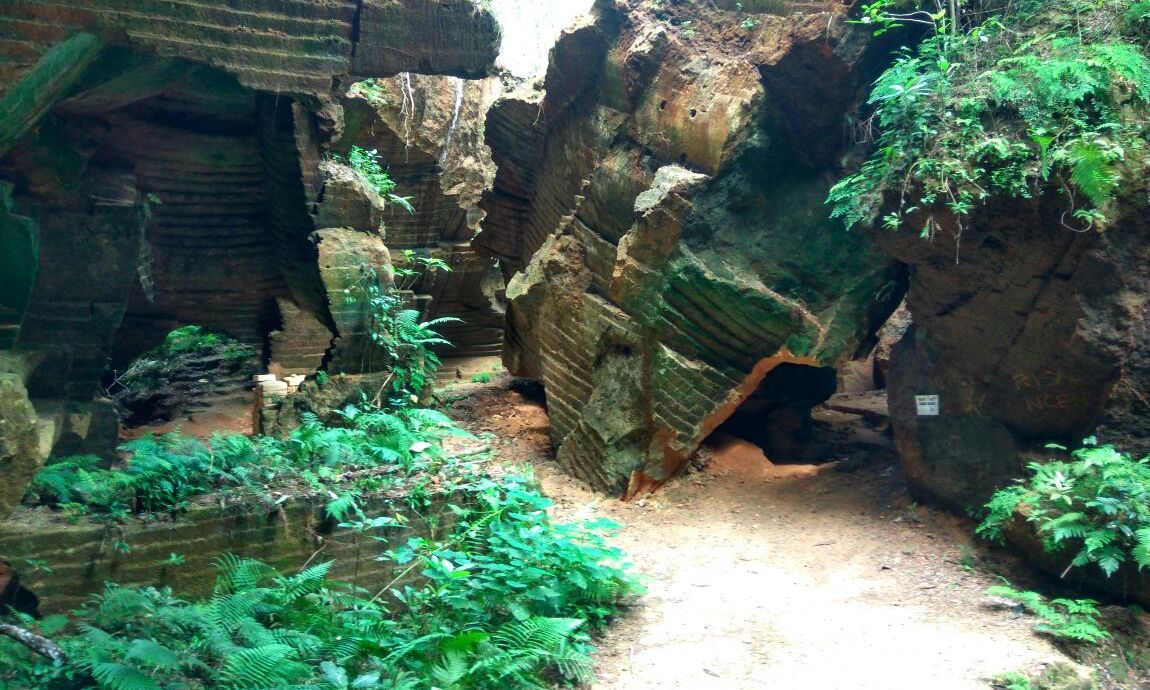
Entering the Stone Garden Area is like coming to a different world. Everything looks yellow and light brown with green topping, it is how it looks when the sun light hit the area. It was initially a limestone hill, until the surrounding people start to dig an exploit the hills to take the white stone for the building material. As the result, they created magnificent shape from the remaining hills. Pillars and tunnels or even caves in some part of the Stone Garden can be found. As it was long abandoned, the nature started to reclaim the area. Plants grow on whatever places it can grow, adding the beauty of the Stone Garden. As if the nature created it.

Some point, remind us of the inner side of the Giza Pyramid in Egypt. As if we are exploring the Pyramid itself. When no other visitors around, for sure you'll feel the creep out of the place. Its silence, dark tunnels, and the vines makes you feel like you are in the movie "The Ruins", or maybe Indiana Jones all over again. Just make sure you're not exploring alone, you might get lost and never comeback. Well, I don't think so.

Artificial Pond

The Gate

Tunnels at Stone Garden 1

Inner Pathway

Stone Garden 2


Going to the second Stone Garden is even more creepy. But, it is the feeling that will make you want to come again. The old abandoned limestone mine creates huge cave, like the big cathedral. It is so big that it has its own hall with around ten meters high or more ceiling. Decorated with huge pillars in some points.

Some part of this man-made cave is filled by water. It adds the creepy sensation while you are in the cave. One good thing is that the heavenly light coming from the ceiling hole right in the middle of the cathedral. As you go deeper in the cave, the surrounding will get darker. Some places are really dark, you can never find what is there without light on your hand. A more area filled with water are found. Though it looks shallow, I'm sure that you don't wanna go into the water.

I found a very nice spot deep in the cave. Where the light could come in, on a big rocks with green bushes on it. Underneath the rocks is a shallow water. I thought I found a piece of paradise here. This is the most beautiful scene I have ever encountered in the cave. Though the surrounding is creepier than the horror movies.

On the corner of this piece of paradise, we can find a path that connects to the other big hall. Some part is an open area with sun light. The rest is a huge circular cave, only this time everything is clear to see. The vines on the walls and some other plants that grow randomly, have constructed an artificial Eden. A breathtaking view that make me forget the creep earlier.

Arosbaya Stone Garden 1 and 2 or they call it Bukit Kapur 1 dan 2, are a must visit destinations when you explore Madura Island. Do not forget to stop by at the Bebek Sinjay for the delicious fried duck with Sambal dipping on your way home. It will make your visit even more memorable.

Pond nearby entrance

The Piece of Paradise

The Grand hall

Eden at Stone Garden 2

Eden at Stone Garden 2

Second Hall
Complete Story »

Saturday, September 2, 2017

Oud Batavia, Java's First Dutch Colony

0
Central Colonial Government Building

Batavia and The Spice Islands


Oud Batavia or translated into English as Old Batavia, is the name given to the area which now known as Kota Tua Jakarta. It was the central administrative district under the Dutch Colonial Government of the East Indies for as long as 326 years. Started as a port city built on the ruin of formerly Jayakarta city which was under the Demak Sultanate. The Dutch East Indies Company or the VOC attacked and destroyed the city of Jayakarta in 1619 under the first Governoor Jan Pietherzoon Coen. He built a new town named Batavia one year later. It became the Dutch and European first settlement in Java.

Spices were the main reason for the coming of the European to the East Indies (former name for Indonesia archipelago). First came the Portuguese, then the Spanish, followed by the Dutch and British later. The earliest arrival of the Portuguese trading ship can be traced back in the 16th CE. Yet they were the first to travel the world to the west by the sea.

The competition were very ugly, they did not hesitate to use violence in order to dominate the spice Islands and the spice trading in the past. So the East Indies was divided into different European trading companies. The Spanish has set foot on the Philippines islands, the Portuguese were dominating the Moluccas Islands until they were shifted their central power to Malacca in the Malay Peninsula. Moluccas later on was a Dutch trading territory. And the British set power on the Malay Peninsula much later.

It was the Dutch whom earn a warm welcome by the local leaders as the hope for the alliance to get rid of the Portuguese. Hence, they established trading post in many locations in the East Indies. The dispute between the Dutch trading company (VOC) and the king of Banten in the early 17th CE resulted in the shifting of the Dutch trading post to the Jayakarta city on the north east of Banten territory. Coen secretly ordered his men to convert the trading post into a strong fortress. Against the Coen's decision, the leader of Jayakarta city attacked the fortress and Mr.Coen fled to Moluccas Islands.

Surprisingly, the small garrison in the fortress survived, and later on they named the fortress "Batavia"- an ancient name for the Dutch land. Few years later Coen came to Batavia and led 1000 men to attacked and destroyed the city of Jayakarta. On the ruin of Jayakarta city, he established the town of Batavia as the extent to the fortress. The first walled city in the East Indies. As VOC grew larger both in trading capacity and its political power in the archipelago, Batavia city played the role of central government.    

Old Building serve as Museum

Old Residence in Kota Tua Jakarta

Colorful Bikes for Tourists

Toko Merah or The Red Shop, formerly a residence of Dutch Governoor Gustaf Willem Baron Van Inhoff

Batavia Cafe on Fatahillah Square

Cafes nearby Fatahillah Square

Sunda Kelapa Port and Kota Tua Jakarta


Batavia territory was only 15 square hectares. What was the colonial capital of Dutch East Indies has now become the capital of newly born nation of the Republic of Indonesia. Therefore, the name changed to Jakarta. It is the largest city in Indonesia and the main economic power to current day. A modernized city dazzled with skyscrapers in every corner of the capital city.

What is left from the Oud Batavia is Kota Tua Jakarta, bear the status as national heritage. Here we can find many colonial building such as the Dutch East Indies administrative building, the Governoor's former residence and others. They mostly became museums and cafes. A humble place to hang out, yet at the same time we can learn the past. The building's architecture is a reminder to the existence of the European power in the past, though it is not pure in European architecture. It is more a mix between local and European with some other foreign architectural touch.

The square in front of the Government's Office served as ceremonials activities as well as the place to hang the criminals. It was then applied to many cities in Indonesia except for the hanging. It is now the place for both citizen and the tourists to hang out and chill, especially on the weekends.

There is, however, a much older venue that is now still being used as the initial function of its establishment. The Port of Sunda Kelapa, considered as one of the oldest port in Java, as well as the first modern port on the island. Sunda Kelapa was the name of both the port and the preceding town under the Padjajaran Kingdom in the 14th CE. Later on the town was attacked by infamous King Fatahillah of Demak Kingdom and changed the name into Jayakarta literally meaning City of Glory, until the attack of the VOC in 17th CE and changed the name into Batavia. The port remained functioning and grew into the largest port at the colonial era.

Coming to Sunda Kelapa Port is like going back in time where both local and foreign traders anchored their ships and did their activities. Though it is now only serve for local ships to anchor, Sunda Kelapa is still a one place to remind us the past. Big ships made of wood are aligned in great alignment. Some loading activities are seen as tourism object, we can even ride a small boat through the big canal heading to the Java Sea. On the right the big wooden boats and on the left  are local fisherman's boat in many colors. At the end of the canal, the boatman allowed us to climb up to one of the big wooden boat to explore and take great pictures, I am sure that photographers will not miss the moment.  

Colorful Ships

Wooden Ships in line

The Boatman

Loading Activity

The Fisherman's Boats

On Deck

The Myth of 350 Years of Dutch Colonial Era


Do you remember our teachers use to tell us about the Dutch colonial era that had been going for 350 years? Yes, even in many school official books said so. Now let me tell you one thing for sure, it is a myth, and the myth is being told over and over again. How I could come to this conclusion? the answer is to read books, especially books written not for school children.

If we trace back the history of colonial era, it is true that the first European traders came to the archipelago around early 16th CE, and if we calculate the year until the end of colonization in 1945 it will be around 345 years. But you must remember, it was the Portuguese whom set foot on Moluccas spice Islands first, not the Dutch. Yet their first intention was to trade or to search for the spices, which was valuable as gold. The Dutch came later on part of Sumatra Island whom had the same purpose. There was never a colonization in the 16th CE.

The story goes as the European traders tried to gain power in every place they stepped foot. All of them tried to do a monopoly trading with the locals. There was no Indonesia at the time. There were, however, kingdoms and sultanates in the archipelago, each had war one to another. The archipelago had many ports for International trading before the European came. Traders from China, India and Indochina had been doing their trading activities in these ports.

The colonization itself started in the 17th CE where the Portuguese managed to get rid of Malaka Sultanate on the Malay Peninsula, Dutch set power in Batavia and Moluccas islands and the Spanish colonized the Philipines Islands long before those two. Yet there were still many independence kingdoms and sultanates in the archipelago. These are Aceh, Jambi and Palembang in Sumatra; Makassar and Gowa in Sulawesi;  Banten, Mataram and Blambangan in Java; Ternate and Tidore  in Mollucas; Sambas and Banjar in Kalimantan or Borneo and many others. Bali and Aceh remained independence until the year 1910.

It was the need for both parties - the Colonial Dutch and Indonesian Nationalist - in the late 19th and early 20th Century. The Colonial Dutch first spread the propaganda of Dutch Rule in the archipelago for 350 years in order to maintain their colonial power as if the locals didn't have a chance to gain their freedom. One Governoor use to say, the Dutch had been in the archipelago for 350 years and will remain here for the next 350 years. On the other hand, the Indonesian Nationalist used the Myth to awaken the awareness of the people for the need of Independence. The myth could make all people across the archipelago had the same feeling of being colonized and being ruled by foreign people. This could encourage them to fight back and established an independence nation.

Well, for me, the myth was made for both good and bad cause. Depends on what purpose and whom saying it. The problem occurs when it became imaginary fact to the next generation without a proper explanation. As if we were really colonized by the Dutch for over than three centuries. It is now the good time to change the myth into the real history in whatever materials being spoken, especially to the school books written to the Indonesian students.

Si Jagur Canon  
Complete Story »

Recent Comments